

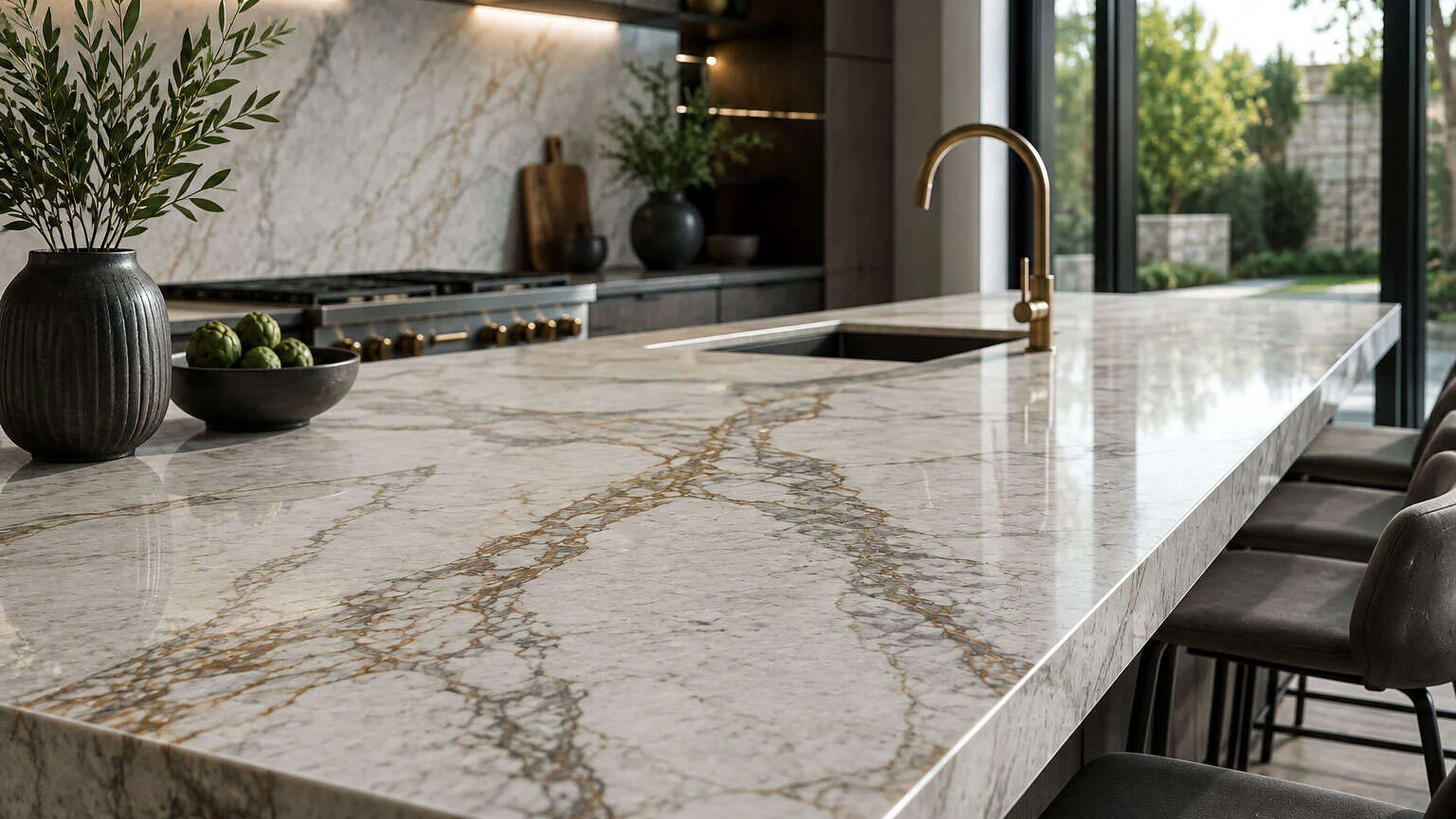
Porcelain countertops for kitchens have migrated from Europe and become mainstream American favorites for good reasons. They handle heat, sun, and scratches better than almost anything else. And they’re thin enough to go into places where other slabs won’t work. Here’s an honest look at the benefits, the drawbacks, and the cost associated with porcelain countertops.
What are porcelain countertops?
Porcelain countertops are large-format slabs made from refined clays and minerals that are fired hard in extremely high temperatures. The results are dense, non-porous surfaces, often imprinted with the looks of natural stone. Zion Stone Gallery carries Florim porcelain, one of the industry’s leading manufacturers.
How does porcelain compare to granite and quartz?
The biggest distinction is that porcelain slabs are engineered more like a high-performance ceramic surface, while granite is natural stone and quartz is an engineered stone. Each has different characteristics for durability, appearance, maintenance, and installation considerations.
| Feature | Porcelain Slabs | Granite | Quartz |
|---|---|---|---|
| Heat Resistance | ★★★★★ Excellent | ★★★★★ Excellent | ★★★ Good |
| Scratch Resistance | ★★★★★ Excellent | ★★★★ Very good | ★★★★ Very good |
| Stain Resistance | ★★★★★ Excellent | ★★★★ Very good | ★★★★★ Excellent |
| UV Resistance | ★★★★★ Excellent | ★★★★★ Excellent | ★★–★★★ Varies |
| Maintenance | Very Low | Low–moderate | Very low |
| Sealing | Generally unnecessary | Usually recommended | Generally unnecessary |
| Natural Appearance | Excellent, but manufactured | Unique / natural | Consistent / manufactured |
| Color & Pattern Choices | Very broad | Naturally limited | Extremely broad |
| Fabrication | More difficult | Experienced fabricators readily available | Experienced fabricators readily available |
| Chipping Risk | Edges can be vulnerable | Edges can chip | Edges can chip |
| Large-Format Capability | Excellent | Limited by slab size / weight | Good |
| Outdoor Use | Excellent | Excellent | Often less suitable |
4 Areas where porcelain really shines
1. Exceptional heat resistance
This is one of porcelain’s biggest advantages. A hot pan or baking dish is generally much less concerning on porcelain than on quartz. Quartz contains resins that will discolor in sufficiently high heat or prolonged exposure to the sun.
Granite also handles heat extremely well, so porcelain’s advantage here is primarily over quartz.
2. Outstanding stain resistance
Porcelain is extremely dense and nonporous. Wine, coffee, oil, tomato sauce, and other substances generally don’t penetrate its surface.
Granite is also highly durable, but because it is natural stone, its porosity varies. Granite countertops benefit from periodic sealing.
Quartz has some stain resistant and, for most homeowners, requires essentially no maintenance.
3. Excellent for outdoor applications
Porcelain is particularly attractive for outdoor kitchens, patios and other areas exposed to sunlight. It doesn’t have the UV concerns associated with quartz.
This is an important consideration in Southern Nevada, where intense sunlight and heat are huge factors.
4. Excellent design possibilities
Porcelain can mimic the appearance of marble, travertine, concrete, wood and other materials. Large slabs can create dramatic looks with very few seams.
That’s particularly attractive for large kitchen islands, backsplashes, and expansive shower walls.
Benefits of porcelain countertops
Porcelain resists heat, scratches, UV fading, and stains. It is completely non-porous so it never needs sealing. It’s also thin and relatively light, which makes it ideal for outdoor kitchens, cladding, and even resurfacing.
Drawbacks of porcelain countertops
The trade-offs are real: porcelain edges are prone to chipping when bumped hard or struck. Edging profiles are more limited than with thicker natural stone. And on some porcelain slabs the pattern is surface level so a deep chip will show the lighter colored makeup underneath it. Skilled fabrication matters more in the production of porcelain than with other engineered composites. And certainly, quartz and even natural granite are more durable.
Porcelain vs. quartz vs. granite
Porcelain beats quartz for heat and UV resistance. As you may have experienced with quartz, it can discolor with sustained heat or with prolonged exposure to the sun. While porcelain beats granite for low maintenance, quartz offers thicker slabs, more durability on the edges, and a softer look.
Indoor and outdoor uses for porcelain
Because porcelain is UV-resistant and stable when exposed to freezing temperatures, it’s one of the best choices for outdoor kitchens. It is phenomenal indoors for counters, backsplashes, floors, and wall cladding.
Cost
Porcelain is competitively priced in comparison to mid-to-high-quality quartz and granite. Now, for certain fabrication specs or applications, tooling requirements can might add additional cost.
Is porcelain right for you? The overall takeaway
Porcelain = best all-around performance, particularly where heat, UV, and stain resistance matters and where large-format applications are important.
When heat, UV exposure, or outdoor applications are part of your plans, porcelain deserves serious consideration. Stop by Zion Stone Gallery to see Florim porcelain slabs and to talk through your project with the best countertop providers in the southwestern United States.
