
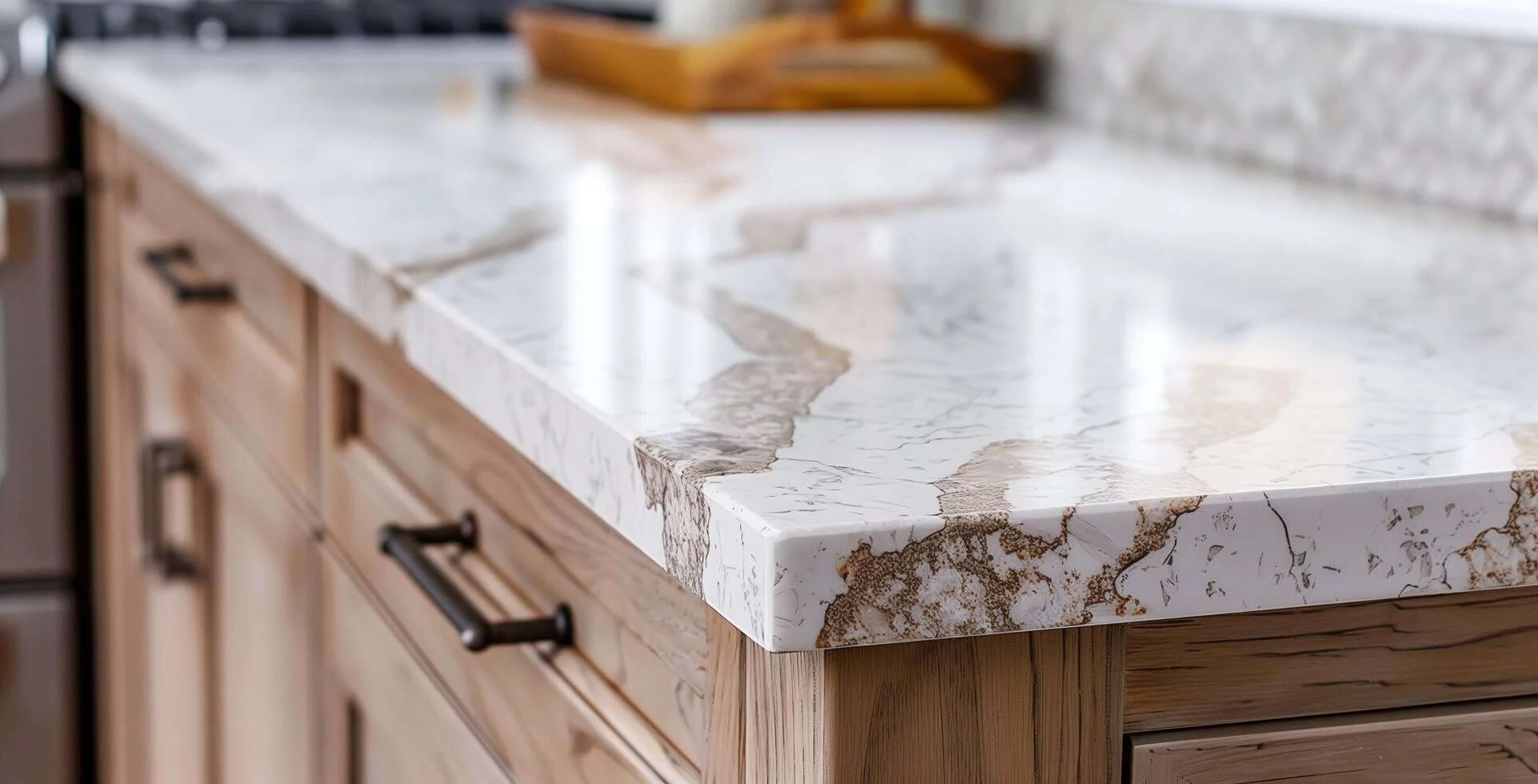
When people select natural stone countertops, they obsess over the slab. The movement. The veining. The color. All valid.
Then they treat the edge profile like an afterthought.
That tiny perimeter detail quietly controls the entire visual language of your kitchen or bath. It affects how light hits the surface, how thick the stone appears, how formal the space feels, how safe it is for kids, and how much fabrication will cost.
Choosing the right stone countertop edge profile is not decorative fluff. It is architectural.
Let’s break it down properly.
Why Edge Profiles Matter More Than You Think
The edge profile is the finished shape of the exposed perimeter of your countertop. It influences:
- Perceived thickness and weight
- Style alignment, modern vs traditional
- Durability and chip resistance
- Fabrication time and cost
The Most Common Stone Countertop Edge Profiles
1. Eased Edge
Best for: Modern, transitional, and minimalist spaces
An eased edge looks straight at first glance, but the sharp top corner is slightly softened. It is clean, simple, and incredibly versatile.
Why designers love it:
- Works with almost every stone type
- Minimizes chipping compared to a sharp 90° cut
- Keeps the focus on the slab movement
2. Beveled Edge
- Reflects light beautifully
- Adds refinement without heaviness
- Slightly more formal than eased

3. Bullnose and Half Bullnose
Best for: Family homes, traditional designs, high traffic kitchens
A full bullnose is completely rounded. A half bullnose rounds only the top edge.
Why they work:
- No sharp corners
- Safer for children
- Soft, classic aesthetic
4. Ogee Edge
Best for: Traditional, formal, and luxury interiors
The ogee edge features an S-shaped curve. It is decorative and distinctly classic.
Considerations:
- Works beautifully with marble and elegant quartzite
- More labor intensive
- Adds visual weight and formality
If your design leans historic or European-inspired, this detail reinforces that story.

5. Mitered Edge
Best for: Statement islands and contemporary luxury
A mitered edge joins two pieces at a 45° angle to create the appearance of a thicker slab.
Why it matters:
- Creates dramatic visual thickness
- Elevates modern spaces
- Perfect for bold island features
6. Waterfall Edge
Best for: Contemporary, high-impact kitchens
Technically not just an edge profile, but too important to ignore. A waterfall edge continues the stone vertically down the sides of an island.
Why designers specify it:
- Showcases dramatic veining
- Creates sculptural impact
- Protects cabinetry edges
This is where material selection and edge planning must align from day one.
How to Choose the Right Countertop Edge for Your Project
Here is the practical framework most people skip.
1. Start with Design Style
- Modern: Eased or mitered
- Transitional: Eased or beveled
- Traditional: Bullnose or ogee Contemporary statement: Mitered or waterfall
Your edge should reinforce the architectural language of the space, not fight it.

2. Consider the Stone Type
- Marble: Works beautifully with ogee, beveled, or eased
- Quartzite: Ideal for eased, mitered, or waterfall applications
- Granite: Flexible across most profiles
- Outdoor applications: Simpler edges tend to perform better long term
3. Think About Function and Durability
If this is a high traffic family kitchen:
- Avoid overly sharp edges
- Consider half bullnose or eased
If it is a formal powder bath:
- You can lean decorative
4. Understand Fabrication and Cost Impact
More complex profiles require:
- Additional labor
- Specialized tooling
- Increased fabrication time
For builders and contractors, this affects timelines and budgets. For designers, it affects client expectations. Choosing the right profile early prevents last-minute changes that ripple through the project.
The Final Step: See It in Person
Edge profiles look different in real life than they do in a diagram. The way light hits the curve. The way the stone thickness feels under your hand. The way it pairs with cabinetry.
At Zion Stone Gallery, edge profile selection is part of the material consultation process. Our team works with designers, builders, and homeowners to ensure the edge detail enhances the slab, not distracts from it.
Because natural stone is not just a surface. It is an experience. And the smallest details are often the ones that elevate a space from good to unforgettable.
